Autonomy, Cybercab & Robotaxi
FSD is the supervised product you can buy today. Tesla's actual goal is unsupervised autonomy — a car that drives you, an app that summons one, and a network of purpose-built vehicles to serve cities. Here's the strategy, the hardware, and the milestones that already shipped.
The vision-only bet
Most companies pursuing autonomy stack LiDAR, radar, ultrasonics, and HD pre-mapping on top of cameras. Tesla's contrarian thesis: roads were designed for human drivers with two eyes and a brain, so the right autonomy system uses cameras and a much, much bigger brain. Since 2021 Teslas have shipped without forward radar, and since 2022 without ultrasonic sensors — pure Tesla Vision.
Eight cameras give the car ~360° coverage at up to 250 m of forward range. Internally, perception fuses those streams into a unified 3D representation (the "occupancy network") the planner can act on.
End-to-end neural networks
Classical self-driving stacks chain a perception module → prediction → planner → controller, each hand-engineered. FSD v12 collapsed that into a single end-to-end neural network: raw video frames in, vehicle controls out. The whole driving policy is learned from data, not coded by hand.
This is why every additional fleet mile matters. Roughly 7+ million Teslas on the road (as of 2025) provide the curated video diet that the next FSD model trains on — a data moat that, in Tesla's view, is the hardest part of the autonomy stack to replicate.
Dojo and the training stack
Training a video-native end-to-end driving model is one of the most compute-intensive tasks in industry. Tesla runs a hybrid stack:
- NVIDIA H100 / H200 GPU clusters for general model training, scaled into the hundreds of thousands of GPU-equivalents.
- Dojo: Tesla's in-house D1 chip and custom ExaPOD architecture, purpose-built for video training throughput. First production tiles came online in 2023; capacity has been expanding since.
The fleet, the training compute, and the inference chip (HW4 / AI4) are all designed to progress together — each new generation of inference hardware lets bigger models ship to the car.
Cybercab — purpose-built robotaxi
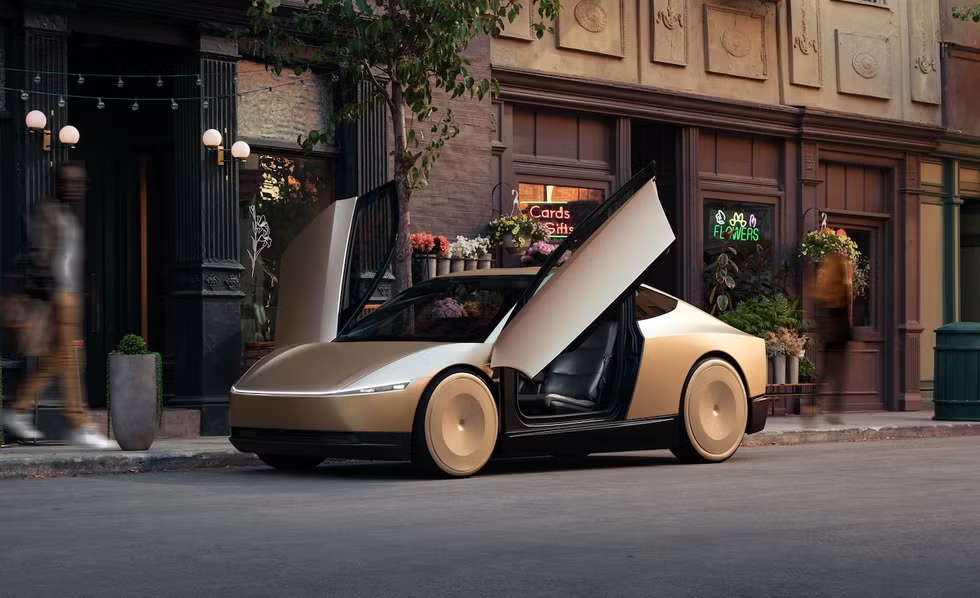
Unveiled at the "We, Robot" event on October 10, 2024, the Cybercab is Tesla's dedicated robotaxi: two seats, no steering wheel, no pedals, butterfly doors, and inductive (wireless) charging. Elon Musk announced a target price under $30,000 and a production goal beginning in 2026 at Giga Texas.
Cybercab is not the only robotaxi Tesla will operate — the existing Model 3 and Model Y fleet runs the same FSD stack and is what actually launched the service.
Robotaxi service — Austin, June 2025
Tesla launched a limited Robotaxi service in Austin, Texas on June 22, 2025, using Model Y vehicles running FSD with a Tesla employee monitoring from the passenger seat. The service area, fleet size, and supervision policy have been expanding through 2025–2026, with additional metros being staged.
Ohio is not in the initial rollout, but the same FSD that powers a Robotaxi in Austin is the same software that updates over the air to your Tesla in Cleveland or Columbus — every Ohio owner is part of the data and validation flywheel.
Dates, prices, and product plans reflect public Tesla announcements through 2025. Tesla regularly revises timelines — treat any forward-looking date as a target, not a promise.