
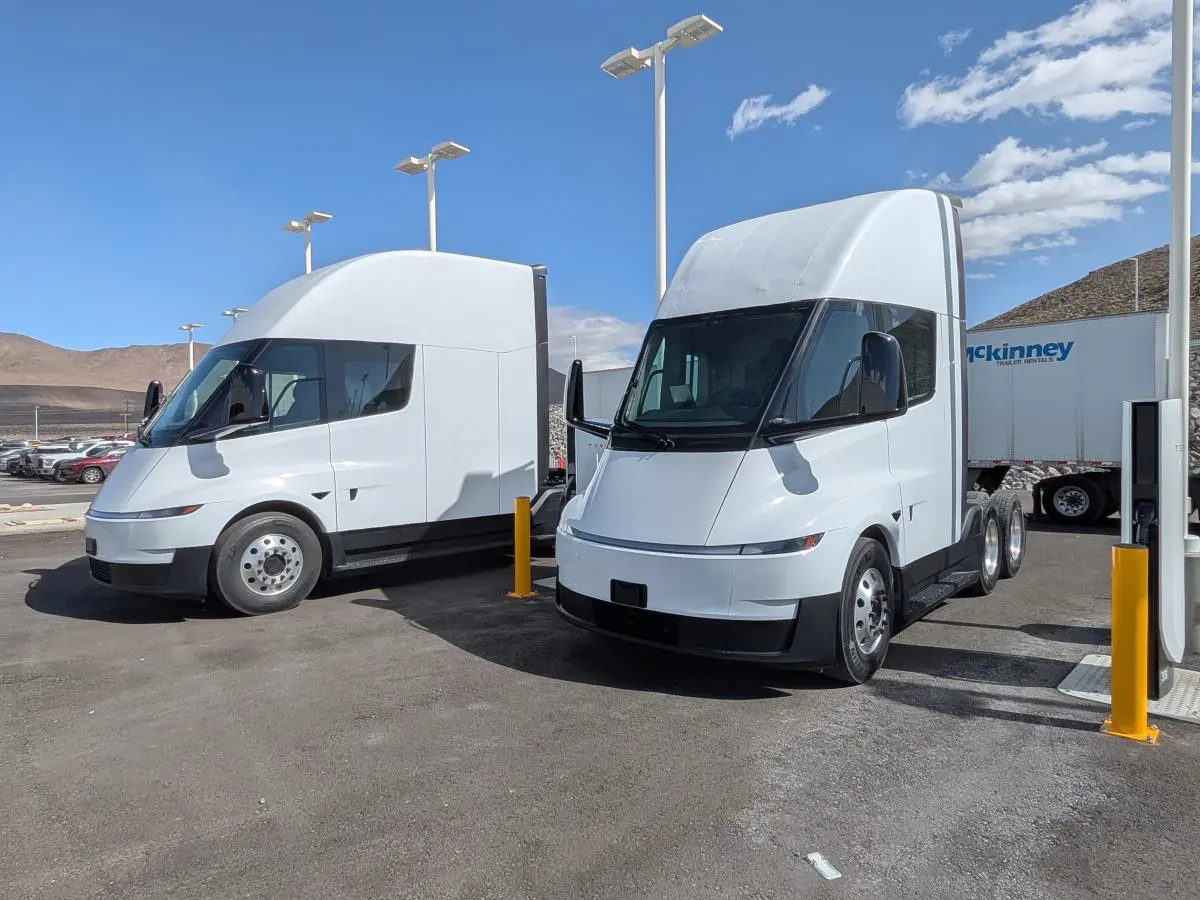
What the Semi is
Tesla unveiled the Semi in 2017 and began customer deliveries in December 2022 with PepsiCo as the launch fleet. It's a Class 8 tractor — the same weight class as a Kenworth T680 or Freightliner Cascadia — but powered by three independent rear motors and a large battery pack instead of a diesel powertrain.
The cab is built around a centered driver seat with two screens flanking the wheel, full standing-height interior, and a low, aerodynamic nose that gives the driver a downward forward view no diesel sleeper can match. It runs on Tesla's vehicle software stack, so Semi gets OTA updates the same way your Model 3 or Model Y does.
Why Ohio is a perfect proving ground
"I-70, I-71, I-75, I-77, I-80, and I-90 all cut through the state. A huge share of everything moving between the East Coast, the Great Lakes, and the manufacturing belt touches Ohio pavement."
Columbus, Cincinnati, Cleveland, Toledo, and Youngstown are some of the busiest inland freight hubs in the country. On top of that, Ohio is a manufacturing state — steel, automotive, appliances, food and beverage, plastics, and now semiconductors and EV battery plants. All of that input and output rides on Class 8 trucks. The same fleets running between an Ohio plant and a regional DC are exactly the lanes Semi was designed to electrify first.
Running a Semi in Ohio? Tell us.
Fleet operator, shipper, manufacturer, owner-operator, or driver with a Semi pilot, an early reservation, a depot-charging build-out, or first-hand seat time — we want to gather those stories and share them with the Ohio Tesla community.
We're also happy to make introductions: fleet to fleet, driver to driver, charging contractors, utility folks, and neighboring-state Tesla Owners Clubs. The club is a news, education, and social club — we don't sell Tesla products or services. Connecting people is what we do.
Talk to the club →Two versions, one platform
Same Class 8 platform, cab, and tri-motor powertrain. The difference is battery pack size — which changes range, payload headroom, and the kind of routes each one fits best.
Short-haul lanes
DC-to-DC, port drayage, same-day delivery loops. Smaller pack means lighter tractor weight and more usable payload, with depot charging overnight on industrial power.
Interstate freight
Lanes that previously required a diesel sleeper. Demonstrated by PepsiCo on a fully loaded 500-mile run in November 2022 — the version that opens up long-haul once Megacharger build-out catches up.
Pricing Tesla announced at the 2017 reveal was roughly $150,000 (300-mile) and $180,000 (500-mile); current production pricing has not been re-published. For the latest, visit Tesla.com/semi.
Where Semi makes sense first
Purpose-built for high-utilization regional and long-haul freight where a diesel truck burns the most fuel and produces the most emissions.
Tesla is scaling Semi production at a dedicated factory in Reno, Nevada, with volume production targeted as the line ramps in 2026. For the latest order info and configuration, visit Tesla directly .
Emissions and operating cost
A Class 8 diesel sleeper burns 20,000+ gallons of diesel a year on long-haul duty. Replacing one removes on the order of 200+ metric tons of CO₂ annually, plus the NOx and particulate pollution that hits hardest along freight corridors and warehouse neighborhoods.
Fewer moving parts, regenerative braking on every downhill, and per-mile energy cost competitive with — and at industrial power rates often well below — diesel on the same route. Semi was designed to win on TCO, not just emissions.
Charging — and the corridor question
Semi charges on Megacharger, a high-power DC fast-charging standard Tesla developed specifically for Class 8. Tesla and partners (including PepsiCo and the federal government via grants) are building out public Megacharger sites along the West Coast freight corridor first, with broader Midwest and East Coast expansion to follow.
For Ohio fleets, the most likely first deployments will be depot-charging at the plant or DC — many regional duty cycles fit within the 500-mile range and let the truck charge overnight on cheap industrial power. Public Megacharger build-out along I-70 / I-80 corridors is what unlocks true long-haul lanes through Ohio.
Specs reflect Tesla's published figures and early customer reports through 2025. Real-world range and energy use depend on load, grade, weather, and speed. Production timelines and Megacharger build-out are Tesla targets and can change.