
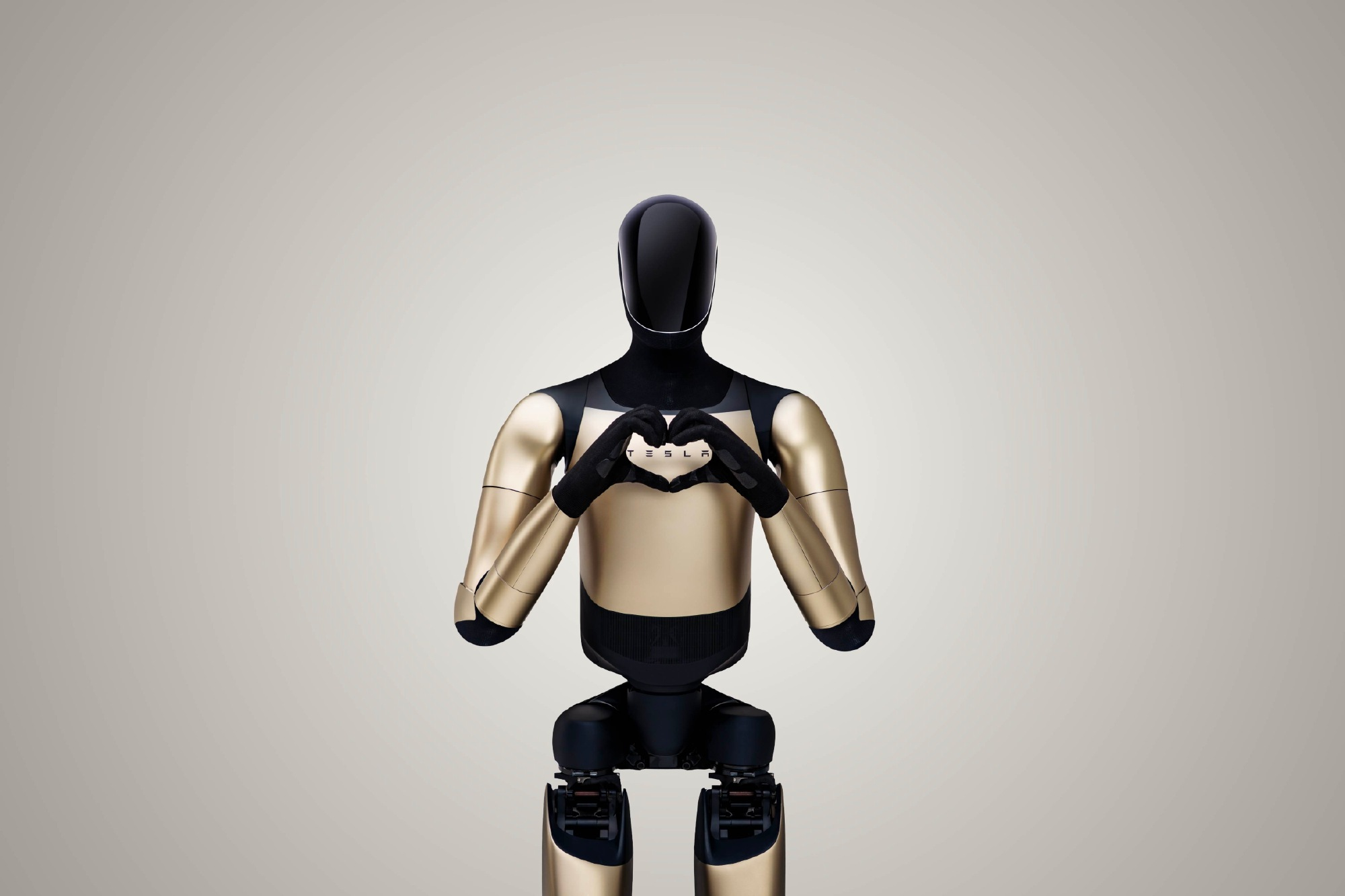
Robotics & Optimus
Tesla Optimus — sometimes called Tesla Bot — is a general-purpose humanoid robot built on the same vision, neural-net, and inference hardware that drives the cars. Elon Musk has publicly said the long-term Optimus business could exceed Tesla's vehicle business. Here is what has actually shipped so far and what is in flight.
The product, in plain terms
Optimus is a bipedal humanoid robot designed to do work people don't want to do, or can't do safely — repetitive factory tasks, lifting, carrying, sorting, eventually household chores. It walks, balances, manipulates objects with multi-finger hands, and sees the world through the same kind of camera + neural-net stack as a Tesla vehicle.
It is explicitly a general-purpose platform. Tesla's argument: the marginal cost of adding capability to a humanoid is much lower than building a custom robot for every task, the same way a smartphone replaced dozens of single-purpose devices.
Generations to date
- Concept (AI Day 1, Aug 2021): announced as "Tesla Bot" with a person in a suit on stage — concept only.
- Bumble C (AI Day 2, Sep 2022): first working prototype walked on stage.
- Optimus Gen 1 (2023): tighter integration, in-house actuators, smoother walking gait.
- Optimus Gen 2 (Dec 2023): ~10 kg lighter, ~30% faster walk, new 11-DoF hands with tactile sensing, full Tesla-designed actuators.
- Optimus Gen 3: publicly previewed at the "We, Robot" event in Oct 2024 walking among guests and serving drinks. Refined hands and arms, faster pace of capability work into 2025–2026.
Factory pilot at Giga Texas
Optimus units have been doing real work inside Tesla's Giga Texas factory — moving 4680 battery cells between stations, sorting parts, and other repetitive tasks. Tesla has said the goal is to scale internal Optimus deployment first, then offer the robot externally. That internal pilot is the equivalent of Tesla's fleet for autonomy: a closed-loop environment that generates the training data for the next model.
Pricing and shared autonomy stack
Long-term price target: $20,000–$30,000 per unit at scale. That price requires Tesla-level manufacturing — the same in-house motors, batteries, and vision compute the car business already produces.
Critically, Optimus reuses the autonomy stack: Tesla Vision cameras, end-to-end neural networks, FSD-class inference silicon, and Dojo / GPU training. Every improvement to driving perception is, in part, an improvement to robot perception. That's why Tesla treats "cars + robots" as one AI company rather than two product lines.
Optimus is a development product. Generations, capabilities, and pricing reflect public Tesla disclosures through 2025; commercial availability and final specifications are still evolving.